Online Course
 Rated 4.8 stars
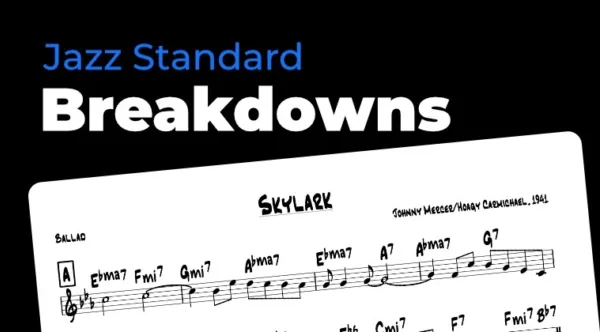
There's a gap most jazz piano students know well. We understand the techniques, and can play exercises with them. But when you open a real lead sheet, something different is required. How do you handle an intro? What happens when the harmony gets complicated in the bridge? How exactly do we turn rote techniques into musical moments?
This course fills that gap with five of the most important jazz standards in the repertoire. All the Things You Are, All of Me, Body and Soul, Blue Bossa, and Nearness of You. Each tune is approached the way I would play them on a real paying gig, with the full voicing and comping vocabulary applied to a real song in real time.
 Introduction Introduction Playing in a 2-Feel Adding 3-Note Voicings Comping Patterns Comping Variety Your Homework Part 1 Part 2 Part 1 Part 2 Learn to play Blue Bossa Learn to play The Nearness of You Part 1 Part 2
Each of these tunes teaches you something specific about how jazz piano actually works. That's why this set matters.
All the Things You Are is probably the most important standard in the jazz repertoire, and one of the most harmonically ambitious. It moves through multiple keys and teaches you how to navigate large harmonic shifts without losing the thread.
All of Me is a shorter form with cleaner harmony, and one of the best tunes for understanding how to hold melody and accompaniment at the same time. This is often the tune where playing jazz stops feeling like practicing jazz.
Body and Soul is a slow, rich ballad with a level of harmonic detail that rewards close attention. Playing it well requires something different from the up-tempo standards: listening, space, and a slower-burn approach to the changes.
Blue Bossa is the Latin tune in the set, and one of the best entry points into playing over a minor key with a bossa feel. If you've only worked in a swing context, this one opens a different pocket entirely.
Nearness of You is a lush ballad that puts the full chord voicing vocabulary to use. Five and six-note voicings, breathing room between phrases, and an approach to melody that makes the song feel like something you've lived with for years.
I wanted to learn Dream a Little Dream of Me, a tune that's not even in the Jazz-Library curriculum.
But after working through the program, I knew exactly how to approach it. I knew how to break down the changes, how to voice the chords, how to work through the melody.
Six weeks later I can comp through the whole thing, swing it, play the melody, add fills, and I'm even starting to solo over the changes, all without the lead sheet. Jazz-Library didn't teach me that tune. It taught me how to learn any tune I want.
Jeff LEven though I already improvise on the piano, it was valuable to go back and work step by step. I tend to practice many bits of different skills at once, which sometimes makes my learning feel scattered. This course gave me a clear direction, allowing me to focus on one goal at a time. It was fun, it motivated me, and the challenge provided me with valuable perspective and new ideas... It will push you further without being too much of a struggle. Now my next challenge is to comp with my left hand with my right hand soloing like Wynton Kelly!
Natalie BWhen I chose to dive into the world of learning to play jazz piano I had no idea of the incredible journey I was embarking on. Over the past several years I have accumulated a significant amount of jazz theory and material: collected many of the theoretical parts that make up jazz but had no clear idea of how to put anything together that made musical sense to me or anyone else. Then I met Josh. Through his online course I saw that he was an instructor who through his clear and simple explanations could help me assemble my knowledge into something playable and musical. Being an accomplished pianist has been a lifelong ambition and Josh's work has made that path easier.
Bruce MAll Video Courses • Live Workshops • Members Community • Learn More
This course is only available to members.
Try everything for 30 days. If it's not working for you, full refund. We'd rather you try it and know it's not for you than wonder if it would have helped.
By using Jazz-Library, you agree to our Cookies Policy.